Digital Games and Design:
Digital games are part of a new wave of learning. This wave has seen games shift from just a leisure activity into games for learning. As this wave is only new there is a lot of conflicting research on the overall benefits of games and design learning. Mayer (2019), argues the incorporating games into the learning process has greater potential to enhance student’s problem-solving skills, produce deeper understandings, engage students with content and foster student creativity, when compared with traditional learning techniques (Mayer, 2019). Currently the position of game design has been integrated within the syllabus as follows; “there is a focus on knowledge and understanding of data, digital systems and their interactions; and computational thinking skills and their application to design and implementation of digital solutions” (ACARA, 2015).
Pedagogical Applications:
The role of the teacher is to guide, support and scaffold student learning when using game design. Additionally, involving students in the learning process can assist in focusing student’s attention and for understanding of the concepts being learnt through the digital games. This can be achieved by outlining the learning intentions to the class, guided questioning and providing clear instructions (Kangas, Koskinen & Krokfors, 2017). Games can be used it the learning process as tools to help foster student-focused learning. Additionally, games design learning offers the chance for students to learn through failure and foster resilience that may not occur during traditional learning methods (Gros, 2007). Whilst there is conflicting research on the overall benefits of games desgin learning, most research specifies the imperative understating needed from both teachers and students of their independent roles (Mayer, 2019).
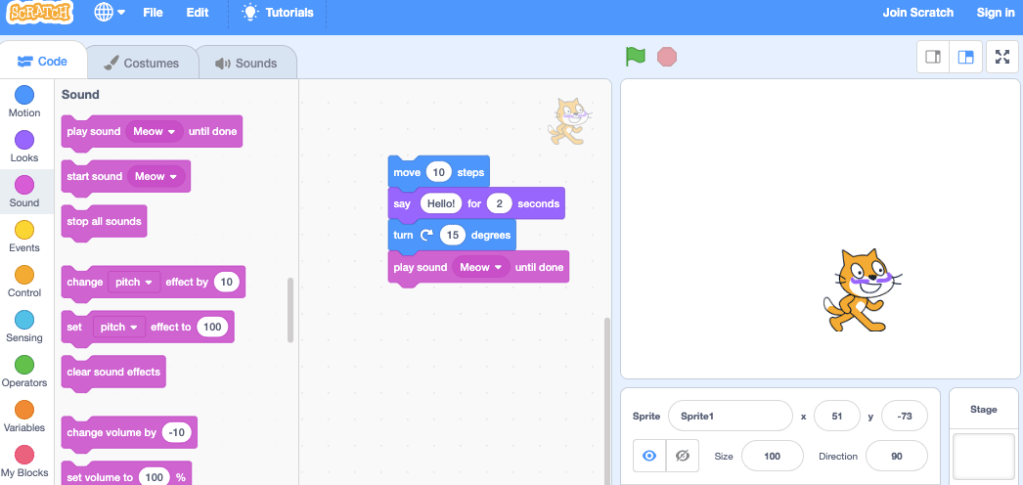
Scratch:
Scratch is a program-based-learning application that allows users to create their own interactive stories, games and animations. Scratch is used as a tool for game creation that can be used to tailor individual learning opportunities for different student needs (Scratch, 2007). This can be accomplished as the teacher can design quizzes, games and classes that target students’ skills. Scratch can be used to assist students in learning to think creatively and develop deeper thinking skills that can be used in the 21st century (Scratch, 2007). This application has the means to form lessons around the different KLA’s such as English, Mathematics, History, Geography and Science (ACARA, 2015). Creativity can be encouraged through the use of Scratch as students use skills to test, plan and construct their game or animations, throughout this process students are constantly testing their creation using their problem-solving skills (Squire, 2006). Whilst scratch has the capability to enhance student learning, I found that without explicit instruction, the program can be difficult to navigate and use efficiently as both the teacher and the student.
References:
Australian Curriculum, Assessment and Reporting Authority [ACARA]. (2015). Content for year 5 – Learning area content descriptions. Sydney, Australia: Author. http://docs.acara.edu.au/resources/Achievement_on_a_Page_Year_5.pdf
Gros, B. (2007). Digital Games in Education. Journal of Research on Technology in Education, [online] 40(1), pp.23–38. Available at: https://www.tandfonline.com/doi/abs/10.1080/15391523.2007.10782494 [Accessed 29 Jun. 2019].
Kangas, M., Koskinen, A., & Krokfors, L. (2017). A qualitative literature review of educational games in the classroom: the teacher’s pedagogical activities. Teachers and Teaching, 23(4), 451-470.
Mayer, R. E. (2019). Computer games in education. Annual review of psychology, 70, 531-549.
Scratch (2007). Scratch. MIT – Imagine, Program, Share. https://scratch.mit.edu/
Squire, K. (2006). From content to context: videogames as designed experience. Educational Researcher, 35(8), 19-29.
 Rebecca Pashley
Hi Rebecca, good explanation of the technology. Did you find it difficult to use, because I got lost for quite a while. Although gaming catch students attention very quickly, can you think of any key learning areas that gaming would be useful in? Also, would game-based design be effective for high school students?
LikeLike
Hey, Thanks for your comment. I did find it rather difficult and I found that without explicit instruction, the program was hard to navigate and use efficiently. From my research i thought the most effective way to use scratch would be in literacy as a way to communicate stories, but for more ideas you can visit this site: http://scratched.gse.harvard.edu/resources/scratch-across-every-subject-recap. With high school I think it could be more effective in social studies lessons.
LikeLike