Constructionism:
Constructionism is defined as learning through doing, where you actively construct and build your own knowledge from being involved and engaging in meaningful experiences (Donaldson, 2014). Constructionism is commonly seen in the classroom when students develop and build upon their different skills within the learning experience, these involve; creative thinking skills, problem solving skills, and within the maker movement (Piaget, 1976).
The Maker Movement:
The Maker Movement has been used within classrooms in a multitude of different ways, the movement focuses on using materials and resources from our environment to solve problems (Martinez & Stager, 2014). Although, more recently with the advancement of educational technology becoming more and more available within today’s classrooms, the Maker Movement has seen re-emergence and been used at a higher frequency. The Movement involves using the available technology and tools to facilitate hands-on, problem-based learning activities (Bower, Stevenson, Falloon, Forbes, & Hatzigianni, 2018). Underpinning the Maker Movement is the understanding that students are competent and adaptable learners, who use, explore and investigate the digital technologies and tools to become experts (Martinez & Stager, 2014). Students design and construct using these digital technologies and tools creating physical objects, they actively contribute and engage with the tools in a collaborative and co-operative learning environment, this aims to promote creative think skills, problem-based learning and deliver student focused learning (Bower et al. 2018).
MakeyMakey:
MakeyMakey is an application that adopts constructivism learning methods and follow the Maker Movement. It is a technology aimed to promote student focused learning and involves learners to design, construct, manage and code programs, essentially it is an ‘Invention Kit’ that allows users to turn anything capable of conducting electricity into a computer (Powers, 2019); (MakeyMakey, 2019). This technology permits students to use problem solving skills, creative thinking skills and use higher order thinking (ACARA, 2012).
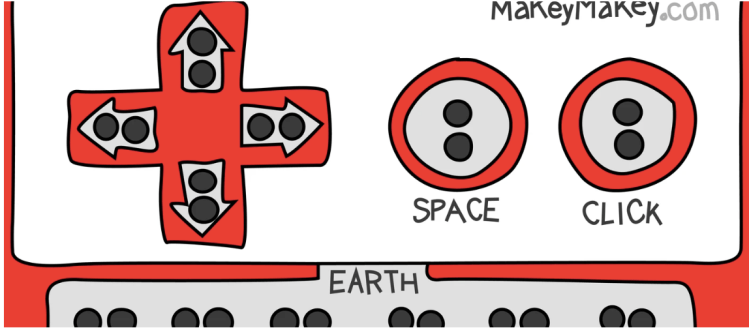
MakeyMakey allows users to connect objects from the world of things around them to a computer program in which users code to create banana pianos, game controllers and musical instruments to name a few (MakeyMakey, 2019). MakeyMakey supports the aims of Maker Movement as it provides students the tools to investigate their creativity and use a ‘hands-on approach’ in understanding digital technologies through a problem based independent learning focus (MakeyMakey, 2019). The open-ended structure of the MakeyMakey technology, used in conjunction with real world applications allows students to further develop problem-solving skills and provides students the opportunity to explore different creative platforms (Papert & Harel, 1991).
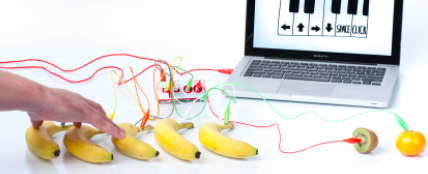
A drawback of the MakeyMakey technology is the cord length of the alligator clips, the short length makes larger scale inventions hard to accommodate and makes usability slightly unfriendly (Powers, 2019). Additionally, the small features struggle to accommodate for all learners.
References:
ACARA. (2012). Digital technologies. The Australian Curriculum. https://www.australiancurriculum.edu.au/f-10-curriculum/technologies/digital-technologies/
Donaldson, J. (2014). The Maker Movement and the rebirth of Constructionism. Hybrid Pedagogy. Available at: http://www.hybridpedagogy.com/journal/constructionism-reborn/
Bower, M., Stevenson, M., Falloon, G., Forbes, A., & Hatzigianni, M. (2018). Makerspaces in primary school settings: advancing 21st century and STEM capabilities using 3D design and printing.
MakeyMakey. (2019). Makey Shop. https://makeymakey.com/
Martinez, S., & Stager, G. (2014). The maker movement: A learning revolution. Learning & Leading with Technology.
Papert, S., & Harel, I. (1991). Situating constructionism. Constructionism, 36(2), 1-11.
Piaget, J. (1976). Piaget’s theory. In Piaget and his school (pp. 11-23). Springer, Berlin, Heidelberg.
Powers, M. (2019). EdLab, Teachers College Columbia University. https://edlab.tc.columbia.edu/blog/15733-MaKey-MaKey


Hi Rebecca,
I really enjoyed reading your blog post on Constructionism and The Maker Movement. MakeyMakey is a really interesting tool to use in the classroom. There are so many ways to use it and it can be used across a wide range of KLAs. I found it really interesting reading about the drawbacks of the MakeyMakey. You raise a good point about the cord length of the alligator clips and how this can make larger-scale inventions hard to accommodate.
LikeLike
Hey Saskia!
Thank you, and I totally agree. MakeyMakey is a great tool and has opportunities to be used across a wide range of KLA’s. In reference to the draw backs the notes I mentioned can make it hard to accomodate for all learners, but overall I found it a really adaptable any easy to use tool that fosters student creative thinking.
LikeLike