What is virtual reality?
Virtual reality is an interactive computer simulation containing complex and sophisticated illustrations and graphics (Adams, Reid, LeMaster, McKagan, Perkins, Dubson, & Wieman, 2008). The technology provides the user to participate in a life like simulation/virtual exploration that would otherwise not be possible (Abdul Rahim et al., 2012; Sun, Lin, & Wang, 2010; Wei et al., 2013). The computer-generated simulation creates a three-dimensional image or a setting that the user can interact with in a perceived to be ‘real’ and physical manner.
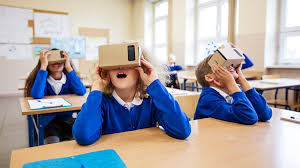
The link between Virtual reality and creativity, and the aim in the classroom
Virtual reality has the potential to facilitate personalized learning experiences, whereby lessons can be custom-made to the requirements of each individual student. The software of virtual reality theoretically allows students to explore and learn at their own independent pace. The design of many experiences fosters students creative thinking and decision making in an interactive and hands on way (Kavanagh, Luxton-Reilly, Wuensche, & Plimmer, 2017).
Another link between Virtual reality and creativity is intrinsic motivation. Intrinsic motivation refers to the internal satisfaction one gains from being immersed in one’s environment, and according to the Journal of Applied Behavioural science the virtual reality environment fosters this creative thinking (Auger & Woodman, 2016). Additionally, In an analysis conducted by Kavanagh, Luxton-Reilly, Wuensche & Plimmer, the majority of teachers surveyed said they use virtual reality as a means to increase the intrinsic motivation of their students. Furthermore, this was achieved with the use of the constructivist pedagogy, group collaboration, and games-based learning within the design of the virtual reality experiences (Kavanagh, Luxton-Reilly, Wuensche, & Plimmer, 2017). In summary Virtual reality aims to play and important role in the classroom by increasing time on task, promoting motivation and intrinsic motivation, heightening enjoyment and increasing long term retention and richer learning experiences (Makransky & Lilleholt, 2018), (Kavanagh, Luxton-Reilly, Wuensche, & Plimmer, 2017).
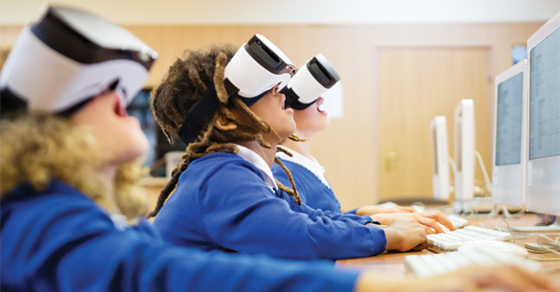
Examples of how Virtual reality can be used in the classroom:
- Simulation– life like simulations and or virtual explorations. (interactive museums, travel)
- Access to limited resources – to simulate the use of resources the school may not have access to.
- Distance Learning – ability to access the classroom from a distance.
- Training simulators – Driving
Drawbacks of Virtual reality in the classroom:
Where there are positives there are always drawback, firstly being an emerging technology in the classroom there is limited information about the impact on the user. Makransky & Lilleholt, argue that the use of Virtual reality in the classroom can impact the learner’s emotional processes during the learning process (Makransky & Lilleholt, 2018). Additionally, using Virtual reality changes the traditional education process, shifting the personal human connection and interpersonal connection to a user and software relationship. This poses the question if Virtual reality is deterioration the human connection? Or damaging the overall human connection between students and their peers (Hicks, 2016). Lastly, and most commonly is the cost and logistics required to implement them into all schools (Kavanagh, Luxton-Reilly, Wuensche, & Plimmer, 2017).
References:
Adams, W.K., Reid, S., LeMaster, R., McKagan, S.B., Perkins, K.K., Dubson, M. & Wieman, C.E. (2008). A Study of Educational Simulations Part I – Engagement and Learning. Journal of Interactive Learning Research, 19(3), 397-419. Waynesville, NC: Association for the Advancement of Computing in Education (AACE). Retrieved March 9, 2020 from https://www.learntechlib.org/primary/p/24230/.
Auger, P., & Woodman, R.W. (2016). Creativity and intrinsic motivation: exploring a complex relationship. The Journal of Applied Behavioural Science, 52(3), 342-366. Doi: 10.1177/0021886316656973
Hicks, P. (2016). Virtual Reality In The Classroom: Advantages And Disadvantages. Educational technology.
Kavanagh, S., Luxton-Reilly, A., Wuensche, B. & Plimmer, B. (2017). A systematic review of Virtual Reality in education. Themes in Science and Technology Education, 10(2), 85-119. Retrieved March 8, 2020 from https://www.learntechlib.org/p/182115/.
Makransky, G., Lilleholt, L. A structural equation modelling investigation of the emotional value of immersive virtual reality in education. Education Tech Research Dev 66, 1141-1164 (2018). https://doi.org/10.1007/s11423-018-9581-2
 Rebecca Pashley